
Case-to-solve game: how to host one at home without stress
Turn your table into an investigation office-same story, same clues, no mandatory costumes.
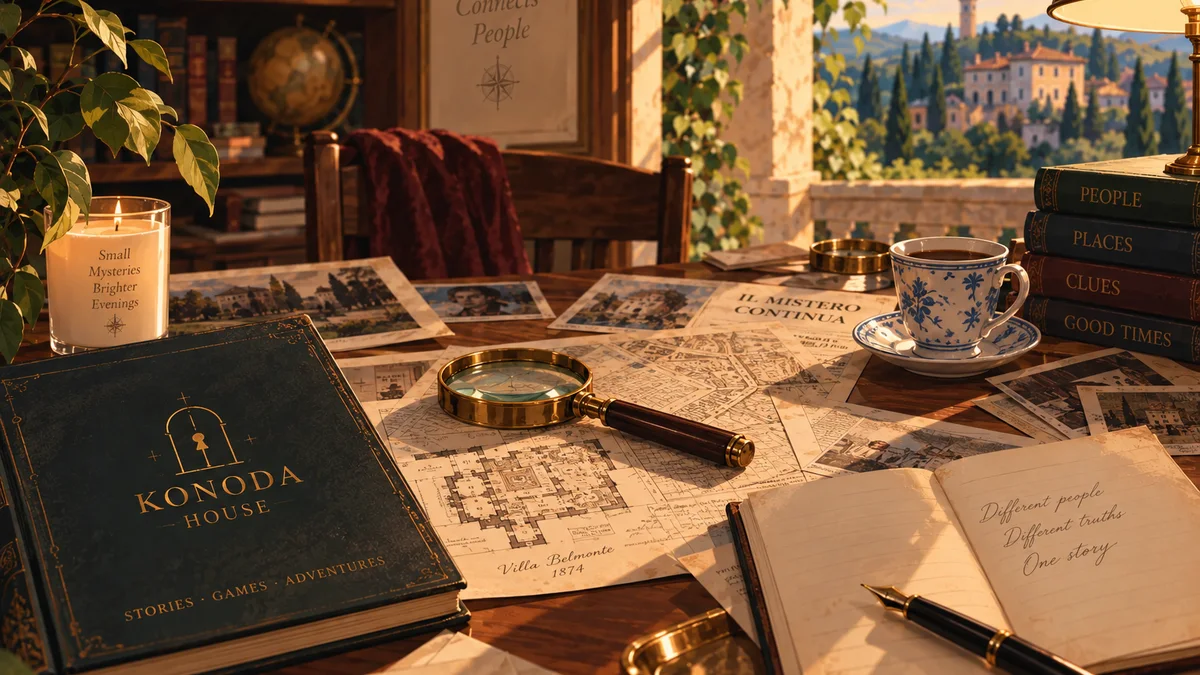
A case-to-solve game at home is the simple idea: without going out or booking an escape room, you turn the living-room table into an investigation office. You do not need a complicated app or a professional host. You need a credible story, documents to read together, and time to discuss until the theory holds. It is ideal for a Friday night, a small birthday, or a gift for a couple who love mysteries.
Online you will find dozens of names: investigation game, murder mystery, dossier, dinner kit. When you search specifically for a case-to-solve game, you usually want less acting and more analysis. Everyone sees the same clues; nobody must lie to others because a role demands it. The goal is collective: work out who lied, what was stolen, or how the crime in the story happened.
This guide helps you choose, prepare, and run a case-to-solve evening without stress. We cover materials, player count, duration, differences between physical kits and PDFs, and mistakes that end the game in thirty minutes with everyone frustrated. The tone is practical-no movie-trailer promises, just what works in a real apartment.
How to pick the right case
On marketplaces and specialist sites you see claims like “the hardest case of the year” with no player count or duration. For a case-to-solve game at home, filter first by headcount and language. Then read reviews about narrative consistency-contradictory clues or arbitrary solutions frustrate more than high difficulty. Finally check for a free preview or tone sample-useful for a group’s first purchase.
Also weigh theme-historical, contemporary, light or dark. A home with children rules out some content even when the game is “just fiction”. Many products list age guidance or warnings; take them seriously. A well-calibrated adult case can be tense without being graphic-look at how violence is handled in the text, not only on the cover.
What a case-to-solve game is
A case-to-solve game presents an event-often a fictional theft or murder-and a set of textual and visual evidence. You are the investigators. There is no individual winner beating others; you all win when the explanation fits the documents. Some cases ask you to name the culprit; others to reconstruct a timeline or recover an object.
The format suits people who dislike classic board games. You do not study rules for hours-you read the brief, understand what to look for, and start. Difficulty comes from detail density, not abstract mechanics. That is why a case-to-solve game is often the gateway to investigative games for friends who usually only play cards or video games.
At home you control atmosphere-warm light, soft music or silence, phones in another room. You are not bound by a venue’s closing time. You can pause, make coffee, continue the next day. For many couples that is a huge advantage over an organised night out.
Party games, escape rooms, and collaborative cases
A murder-mystery dinner party game splits guests into characters with secrets. It is fun but socially demanding-act, accuse, defend. A collaborative case-to-solve game removes that pressure. You read the same dossier, highlight passages, compare witness versions. Shy players can contribute sharp observations without “getting into character”.
At-home escape boxes exist, but they are often closer to a chain of puzzles than a long investigation. A case to solve privileges reading and reasoning. If you love physical escape rooms for the thrill of the clock, the slower start may feel odd; after twenty minutes, as clues pile up, the “we are inside the story” effect is similar.
Choose the format for your group. Outgoing friends who love costumes? Party kit. A couple or three colleagues who want to reason? Collaborative case. Family with teens? Check theme and length. A well-written case-to-solve game can work across generations if the language is not too technical.
What you need on the table
The bare minimum: the case materials (box or printed PDF), pens, blank paper. A folder or clip to keep documents in order helps a lot. If you are more than three, consider printing one copy per two players so nobody is left without a page in front of them while someone reads aloud.
- Opening brief: goal, setting, any content warning.
- Investigation documents: statements, emails, articles, maps.
- Separate solution sheet: open only at the end.
- Space: clear table, good light, few distractions.
For a case-to-solve game at home you do not need mandatory costumes. If you want a light touch, a candle or an aperitif before the brief is enough. Avoid serving an elaborate dinner during reading-food and documents compete for space and attention.
Players: solo, pairs, or groups
Playing a case to solve solo is possible with products designed for 1–2 players. You lose debate but gain focus. Two players is the most balanced format for a romantic or close-friends evening-each reads, then you swap key pages. With three or four, argument appears-two different readings of the same statement can unlock the game.
Beyond five players on one collaborative dossier gets chaotic. For a large group, use a party kit with roles or split into sub-teams with copies-but then you need a case built for that structure. For a standard case-to-solve game, staying within six players is the safest choice.
With children or first-time players, choose short cases with clear language. Explain at the start that you are not competing-you are building a story together. Encourage note-takers and people who ask “obvious” questions. Those often expose the main contradiction.
How long it takes and pacing
Most home cases run between sixty and one hundred twenty minutes. Add time if you include dinner or if the group loves debating every detail. A common mistake is racing to the answer without reading every document-many case-to-solve games hide the decisive clue in an attachment that looks secondary.
Suggested structure: phase one, read the brief and first documents together; phase two, silent or turn-based reading; phase three, open discussion with the timeline at the centre; phase four, final theory and check. If you use hints, decide upfront how many you want-otherwise every doubt becomes a spoiler request.
You can split play across two evenings. A case-to-solve game does not lose value if you pause at a natural cliffhanger-for example after learning two witnesses lie about times. Note theories on paper and resume when you like.
Printable PDF or physical box
A physical box gives a gift feel and pre-cut components. A printable PDF gives immediacy and often lower cost. For a case-to-solve game at home, a PDF is ideal if you have a printer and want to host tomorrow. A box makes sense when buying for someone who never prints or when you want collectible props.
Check language, page count, and whether colour is needed. An English case with an Italian group slows everyone. Print in black and white to save money, but check maps and stamps stay readable. At a print shop, ask for duplex if the file expects it-some case-to-solve games use double-sided layouts.
After the first run, archive the dossier in an envelope and lend it out. That is a social advantage over one-use party kits tied to roles. Just do not leave the solution mixed with play documents.
Frequently asked questions
- Is it different from a classic board game? Yes-here the right theory wins, not points.
- Do you need experience? No, but careful reading and notes help.
- Can you use it as a gift? Yes-especially PDFs with a free preview or a polished box.
- Dinner or not? Better before or at a break, not while reading documents.
- What if we get it wrong? Check the solution and discuss where you lost the thread-that is part of the fun.
From one case to a catalog
After your first case-to-solve game, many groups learn whether they prefer historical stories, contemporary ones, or lighter tones. Keep a list of what worked: length, headcount, felt difficulty. When you buy a second title, compare those notes to the product page instead of generic reviews alone. A PDF with a free preview lowers the risk of buying the wrong tone for your living room.
Building a timeline on the table
Before you accuse anyone, order what you know for certain: times, places, who was present, and when a document was written. Use a blank sheet with columns for confirmed facts and theories still to test. On a mystery night the temptation is to jump to the answer when one strong clue appears; a timeline slows you down and forces you to explain how two events can coexist. Mark contradictions with a circle rather than erasing them-they are often the key to the case. As a couple, one reads while the other writes; in a group, assign someone to update the sheet every ten minutes so nobody loses the thread.
Separating facts, interpretations, and guesses
During discussion it is easy to mix what a statement literally says with what probably happened. Set a simple rule: every claim must point to a document or be labelled as a theory. That habit makes the evening fairer, because quieter players can ask where an idea comes from. In printable mysteries and collaborative dossiers, quality of reasoning matters more than speed. If someone pushes a theory without evidence, ask gently which clue supports it; often the talk opens on a detail everyone read but nobody connected.
Keeping pace without a host
When nobody runs the game, the group should agree on small rules at the start: reading order, break length, and when to open hints. Read the brief together and decide whether to tackle the case in phases or skim all documents before debating. Both methods work; what ruins the night is switching approach halfway without telling anyone. If one voice dominates, rotate who summarises theories every fifteen minutes. If the group stalls, use an official hint instead of searching online-the dossier is designed to unblock you without spoiling everything.
Handling clashes between theories
It is normal for two people to name different suspects at once. Treat theories as drafts to test, not personal identities. When a new document appears, ask whether it confirms, weakens, or leaves each hypothesis unchanged. In collaborative formats there are no secret teams-the goal is a shared explanation. If talk gets heated, take a five-minute break and return to the timeline sheet. Often the dispute is not who is right but one time interpreted two ways.
Common mistakes to avoid
The first mistake is naming the culprit before you have read every material available in that phase. The second is writing on the first printed page and making the dossier hard to pass on. The third is using your phone to check something when the game asks you not to spoil yourself online. The fourth is turning the evening into an individual competition-in collaborative cases the group explanation wins. Finally, do not underestimate fatigue: after ninety minutes reading drops; a break and water beat forcing the answer.
When to use hints
Hints are not failure-they are part of the design. Use them when you have been stuck on the same question for at least ten minutes, not at the first doubt. Read one hint at a time and return to the documents before opening another. In well-written dossiers each hint shifts attention to a detail already there, without naming the culprit. As a couple, avoid buying too many hints out of pride-a smooth evening beats an imaginary score.
Frequently asked questions
- Do you need experience? No, but careful reading and notes help.
- Can you play solo? Many dossiers yes, but discussion enriches the case.
- How long is setup? Usually ten to fifteen minutes to print and sort.
- Dinner or not? Better before or on a break, not while reading statements.
- What if we are wrong? Read the solution and trace the path-that is part of the game.
Dinner and investigation: how to combine them
If you want dinner and play on the same night, separate the two moments clearly. An elaborate meal during document reading ends with sauce on statements and broken conversation. Choose a simple menu served before the brief, or a halfway break with dishes already plated. Full glasses next to prints are a hazard-move drinks and candles away from the paper zone. Atmosphere can stay warm without making every course a theatre scene, unless you deliberately chose a role-based party kit.
Printing, order, and storage
Print in black and white if colour is not essential; use duplex only if readability stays high. Sort by phase or document type and keep the solution in a separate drawer until the end. If you may replay with other friends, do not write on original sheets-use sticky notes or a notebook. Check the PDF is set to A4 if you print in Europe; tight margins can crop crucial dates and names. A local print shop costs little and saves time with larger groups.
Rereading with a method
A second read of a statement costs minutes and often changes everything. When you feel stuck, return to the document that seemed clear and hunt adjectives, numbers, and proper names you skimmed. In well-written cases useful details are not hidden in fine print-they sit in the sentence you read too fast. Mark pages to revisit with a star instead of scattering them. In a group, ask each person which line convinced them of a suspect-comparing reasons reveals different biases.
Closing the evening after the solution
When you open the solution, read it fully before debating who was almost right. Many groups jump to the last page and miss the logical thread. Review which clues were decisive and which were noise-that is the best way to judge whether the case was fair. If you will replay with other friends, set sheets aside without folding maps or tables. A short thank-you to first-time guests helps you plan the next night with less stress.
From one case to a catalog
After your first case-to-solve game, many groups learn whether they prefer historical stories, contemporary ones, or lighter tones. Keep a list of what worked: length, headcount, felt difficulty. When you buy a second title, compare those notes to the product page instead of generic reviews alone. A PDF with a free preview lowers the risk of buying the wrong tone for your living room.
A case to try in your living room
Theft at Venier Palace is a case-to-solve game as a PDF: Venice 1774, a missing portrait, five credible suspects. It works for 1–6 players, about ninety to one hundred twenty minutes, no master or costumes. It is a concrete way to see if the genre suits you before investing in big boxes or party kits. You can try the first documents free to judge tone and difficulty.
Hosting a case-to-solve game at home costs little in equipment and much in shared attention. Pick the right case for your headcount, set the table, and let the story do the rest. If at the end of the evening you still want to reread a statement to see where you went wrong, you have found the right format for future nights.