
Detective board game: games for detectives and home nights
From detective party games to printable dossiers: how to tell which format fits your living room.
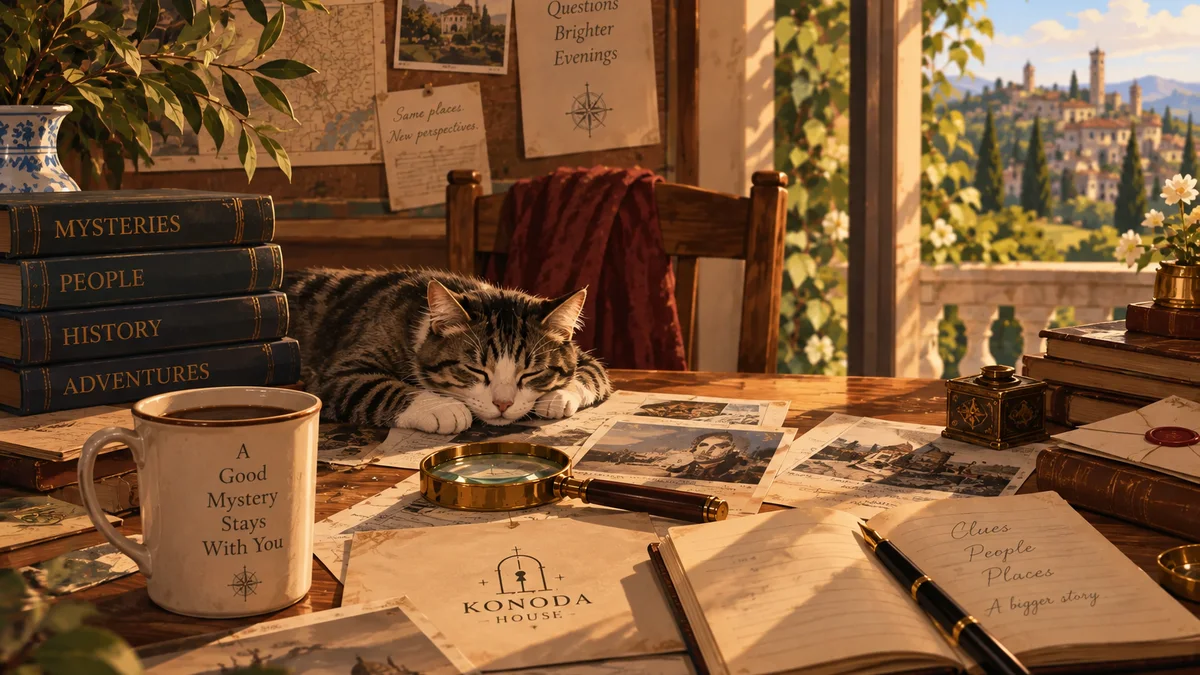
A detective board game, in everyday language, can mean very different products: licensed boxes, detective party games with cards and turns, or dossiers where everyone is on the same team. If you want detective games for the living room, you likely want reasoning, clues, and discussion more than score competition.
Detective games aimed at adults avoid cartoon tone and offer credible documents. The ideal detective board game for a friends' night does not need an expert moderator: it needs attention, respect for minimal rules, and willingness to debate contradictions. This guide distinguishes formats, not brands: the goal is to know what to buy before you fill the shelf, and how to make that title work on the first try.
Detective games: what they have in common
Detective games share a narrative goal: work out what happened before the evening ends. Whether cards, an app, or a printed PDF, the heart is still investigation. You connect motives, opportunity, and evidence, not just score points on an abstract board.
Quality is measured by document consistency and how satisfying the ending feels. A good product makes you doubt several suspects, then shows why only one explanation holds. If the culprit feels pulled from nowhere at the end, the detective format is there but the narrative execution is not.
- Clues spread across documents, not one secret card.
- Suspects with plausible motives, not random names.
- Checkable ending: you can verify whether the theory holds.
Detective board game in a box
A boxed detective board game offers polished components, printed rules, and often an app or support site. Unboxing is part of the pleasure: folded maps, numbered envelopes, tokens that set the tone. For a physical gift or collectors, the box remains a strong option.
The limit is logistics: shipping, space, cumulative price if you add expansions. Some titles also need a tablet or smartphone handy to consult in-game databases. Before buying, check component language and whether your group accepts tech dependency for the whole evening.
Many detective boxes target campaigns: linked cases, recurring characters, growing archives. That works if you play often with the same group; if you meet twice a year, a self-contained one-evening case may be more realistic to finish.
Games for detectives: cooperative or competitive
Some detective games reward whoever closes the case first; others, better suited to the sofa, let the whole group win. Competitive mode can spark the evening if your group likes light rivalry, but it may push toward rushed theories and hidden information.
Collaborative formats align everyone on the same page: same documents, same final question, no secret role that disrupts reading. For shy players or evenings mixing experts and beginners, cooperation lowers social pressure without removing reasoning depth.
Before choosing, ask how you celebrate success: a shared toast or an ironic title for “detective of the night”. There is no universal right answer, but there is one right for your living room.
Detective party game and dinner night
Pairing a detective party game with dinner works if you separate phases: eat first, then open the dossier. Mixing steaming plates and statements to read leads to stained pages and half the group following only the smell of the main course.
If you insist on one block, pick a shorter case or read only the brief during dessert. Leave the dense document phase for when the table is clear and lighting is stable. A glass of water per person beats an elaborate menu during the investigation.
Party kits with costumes and themed menus are another category: fun, but not always compatible with a documentary detective board game. If your goal is reasoning over evidence, keep dinner simple and focus on the pages.
Printable detective games
Detective PDFs arrive instantly, often cost less than shipping a box, and can be reprinted for another group. The trade-off is home print quality: check margins, duplex, and image readability before the evening.
A printable dossier has no tokens or board: text, maps, sometimes envelopes you prepare yourself. For minimal tables that is a plus; for shelf appeal, less so. Many independent authors offer free previews: use them to judge tone and reading load.
Replay depends on you: if you keep the solution separate, you can pass the case to friends who have not seen it. Avoid writing on the only PDF if you plan to replay months later.
Choosing detective games that fit your group
Before buying a detective board game, ask how many you are, how much you enjoy reading, and whether anyone hates acting. A product perfect for five keen readers may bore those who prefer fast cards. Align expectations with one blunt question: do we want to debate for an hour or play thirty minutes?
Check stated age and tone: some detective games for adults include soft but realistic themes. If you host mixed families, read the full description, not only the shop title.
Finally, budget and language: an imported English edition may look great but slow anyone who is not fluent. For a relaxed Italian evening, a PDF or localized box avoids constant pauses to translate terms on documents.
Hosting a detective night without frustration
Assign a light secretary role to update the timeline while others read. Not a game master: they decide nothing, they keep order. Rotate the reader every two documents so nobody tires their voice.
Set a simple social rule: no outside spoilers, no online searches about the case. Fun comes from reasoning with what the game gives you. If you stall, take a five-minute break and return to the opening brief.
End the evening by reading the solution together, even if you guessed right: comparing missed steps is part of learning for the next detective board game you bring home.
From shop to table: what to check on the box
On a detective board game box, look for player count, stated duration, and whether an app is required. Opening the rulebook in store is not always possible, but many publishers post a rules PDF online: five minutes of reading avoids surprises the same evening.
Watch for wording like “expansion required” or “campaign”: you may need several products to finish the story. For a single gift, a self-contained case is safer than chapter one of ten.
If the group includes regular board gamers, ask whether they prefer scoring titles or pure co-op. The same detective evening can be competitive or shared: the right format depends on the mood you want in the living room, not only the crime theme.
A boxed detective board game lends well if your group finished the campaign. Note inside the box which envelopes were opened so the recipient knows what to expect. PDFs reprint for new friends while you keep the solution aside.
Do not dismiss detective games only because they are not replayable with the same core group: many are worth a one-off experience, like a cinema ticket. Cost per hour of play stays reasonable if the evening is full and debated.
When you host people who do not know each other, a collaborative detective board game breaks the ice better than a party game with secret roles. Everyone looks at the same pages, nobody must act well from minute one. The shared goal creates natural conversation around the table.
Keep a timer handy only if the case suggests it: many dossiers have no real-time limit and forcing a race ruins the mood. Use the timer as an optional tool for those who want extra challenge, not pressure on the whole group.
Briefly note what you learned after each evening: too many characters, not enough maps, rules too long. It becomes a personal checklist for the next detective game purchase and avoids repeating expensive mistakes.
Light and background noise matter more than you think: a TV on or lyrical music steals focus while reading statements. Create an atmosphere like reading a mystery chapter, even in slippers. A detective board game does not need a pro game room, it needs respect for concentration.
When trying a new title, spend the first ten minutes agreeing on the case's final question. Without that compass, you may drown in decorative detail. Once aligned on the goal, every document gains purpose and the evening flows with less frustration. Write the question large at the top of your theory sheet so it stays visible even after two hours of reading.
A collaborative dossier to try
For collaborative detective games without expensive licenses, Furto a Palazzo Venier is a printable investigation from Konoda House: Venice 1774, a missing portrait, five credible suspects. It is not a turn-based detective board game with tokens, but a dossier to read together, suited to 1–6 players in about ninety to one hundred twenty minutes. The complete PDF arrives by email right away, so you can judge whether the tone fits your table. It bridges party-friendly accessibility and the depth readers expect from detective games at home.