
Hunt A Killer alternative: a printable case with no subscription
Seasons, props, courier wait. Or a PDF tonight. When each format makes sense.
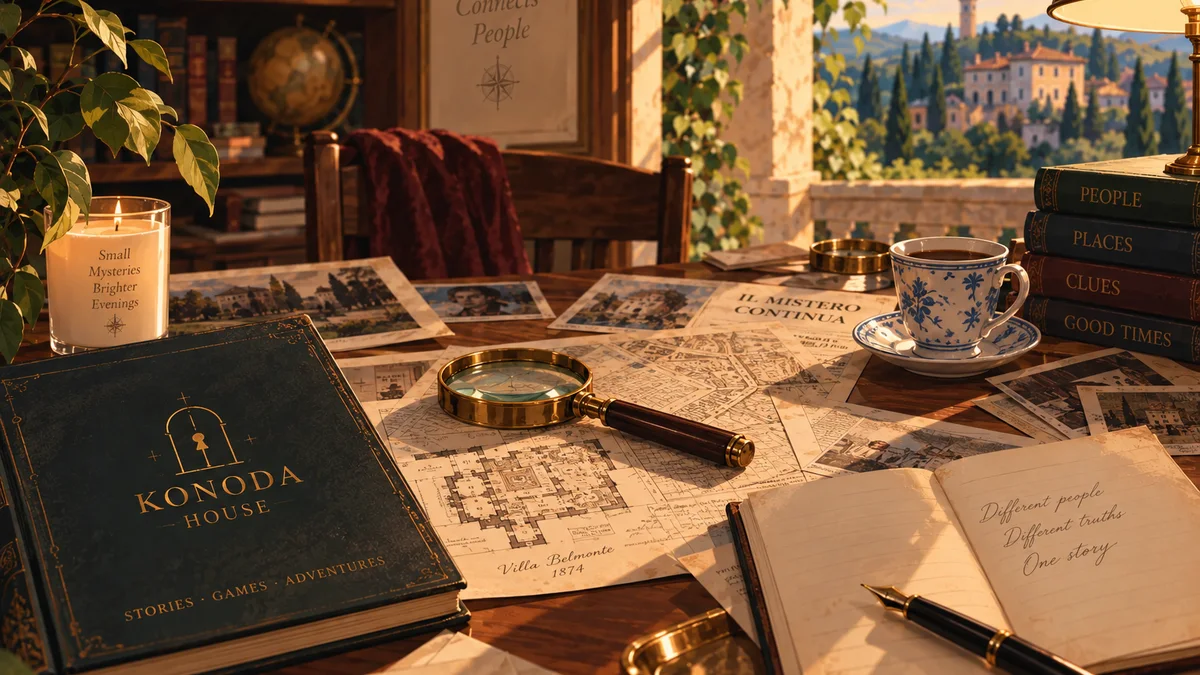
Hunt A Killer is the name that comes up when you want a boxed mystery: physical materials, prestige-TV atmosphere, often a story in episodes. It works. It also costs, and it doesn’t arrive in five minutes. If you wanted that kind of night without a subscription or a wait, a printable detective case is the straight tabletop alternative.
We’re not saying Hunt A Killer “isn’t worth it.” We’re separating two needs: monthly saga with objects vs a closed evening tonight. Mixing them up is like buying a whole TV season when you wanted one film.
What Hunt A Killer does well
- Tactile immersion: props, envelopes, pieces you won’t print at home.
- Long arc: if you like episodic story, a season holds you.
- Object gift: the box on the table feels like a real present.
Where printable wins
- Immediate: download, print, play. No parcel tracking.
- One evening, one case: 90-120 minutes, no months of boxes.
- Price and space: no shelf of unfinished seasons.
- Hints and solution on the site: the printed file stays spoiler-clean.
Costs and timing compared (ballpark)
- Subscription box: monthly commitment, shipping, shelf space for props and envelopes.
- Printable PDF: pay for the case, print, play the same night or weekend.
- Replay: with a physical box you share one season; with a PDF you reprint for other friends (no verbal spoilers).
When to stay with the box
If the joy is opening premium props and riding a long saga, Hunt A Killer (or similar) stays the pick. If the need is “tonight, for two, no going out and no subscription,” a PDF case file is the more honest fit.
How to compare two formats fairly
When you weigh a physical product against a printable dossier, start from your real priorities, not price alone. Ask: how many people play, how much time you have, do you want props or documents to debate, do you need to start tonight? Write three criteria and weight them: immediacy, immersion, player flexibility. One format is not universally better; it is better for that evening. If unsure, read the case description first and compare the table feel with the last box you played.
Replay, gifts, and cost per evening
A physical box is a tangible gift and often lovely to keep, but many narrative cases are usually designed for one play. A PDF may feel less tangible, yet you can reprint for another group if you keep verbal spoilers down. Calculate cost per evening by dividing price by how many groups you can host without ruining the case. For couples who play often, digital dossiers cut shipping and shelf space; for costume parties, party kits remain hard to replace.
Building a timeline on the table
Before you accuse anyone, order what you know for certain: times, places, who was present, and when a document was written. Use a blank sheet with columns for confirmed facts and theories still to test. On a mystery night the temptation is to jump to the answer when one strong clue appears; a timeline slows you down and forces you to explain how two events can coexist. Mark contradictions with a circle rather than erasing them-they are often the key to the case. As a couple, one reads while the other writes; in a group, assign someone to update the sheet every ten minutes so nobody loses the thread.
Separating facts, interpretations, and guesses
During discussion it is easy to mix what a statement literally says with what probably happened. Set a simple rule: every claim must point to a document or be labelled as a theory. That habit makes the evening fairer, because quieter players can ask where an idea comes from. In printable mysteries and collaborative dossiers, quality of reasoning matters more than speed. If someone pushes a theory without evidence, ask gently which clue supports it; often the talk opens on a detail everyone read but nobody connected.
Keeping pace without a host
When nobody runs the game, the group should agree on small rules at the start: reading order, break length, and when to open hints. Read the brief together and decide whether to tackle the case in phases or skim all documents before debating. Both methods work; what ruins the night is switching approach halfway without telling anyone. If one voice dominates, rotate who summarises theories every fifteen minutes. If the group stalls, use an official hint instead of searching online-the dossier is designed to unblock you without spoiling everything.
Handling clashes between theories
It is normal for two people to name different suspects at once. Treat theories as drafts to test, not personal identities. When a new document appears, ask whether it confirms, weakens, or leaves each hypothesis unchanged. In collaborative formats there are no secret teams-the goal is a shared explanation. If talk gets heated, take a five-minute break and return to the timeline sheet. Often the dispute is not who is right but one time interpreted two ways.
Common mistakes to avoid
The first mistake is naming the culprit before you have read every material available in that phase. The second is writing on the first printed page and making the dossier hard to pass on. The third is using your phone to check something when the game asks you not to spoil yourself online. The fourth is turning the evening into an individual competition-in collaborative cases the group explanation wins. Finally, do not underestimate fatigue: after ninety minutes reading drops; a break and water beat forcing the answer.
When to use hints
Hints are not failure-they are part of the design. Use them when you have been stuck on the same question for at least ten minutes, not at the first doubt. Read one hint at a time and return to the documents before opening another. In well-written dossiers each hint shifts attention to a detail already there, without naming the culprit. As a couple, avoid buying too many hints out of pride-a smooth evening beats an imaginary score.
Frequently asked questions
- Do you need experience? No, but careful reading and notes help.
- Can you play solo? Many dossiers yes, but discussion enriches the case.
- How long is setup? Usually ten to fifteen minutes to print and sort.
- Dinner or not? Better before or on a break, not while reading statements.
- What if we are wrong? Read the solution and trace the path-that is part of the game.
Dinner and investigation: how to combine them
If you want dinner and play on the same night, separate the two moments clearly. An elaborate meal during document reading ends with sauce on statements and broken conversation. Choose a simple menu served before the brief, or a halfway break with dishes already plated. Full glasses next to prints are a hazard-move drinks and candles away from the paper zone. Atmosphere can stay warm without making every course a theatre scene, unless you deliberately chose a role-based party kit.
Printing, order, and storage
Print in black and white if colour is not essential; use duplex only if readability stays high. Sort by phase or document type and keep the solution in a separate drawer until the end. If you may replay with other friends, do not write on original sheets-use sticky notes or a notebook. Check the PDF is set to A4 if you print in Europe; tight margins can crop crucial dates and names. A local print shop costs little and saves time with larger groups.
Rereading with a method
A second read of a statement costs minutes and often changes everything. When you feel stuck, return to the document that seemed clear and hunt adjectives, numbers, and proper names you skimmed. In well-written cases useful details are not hidden in fine print-they sit in the sentence you read too fast. Mark pages to revisit with a star instead of scattering them. In a group, ask each person which line convinced them of a suspect-comparing reasons reveals different biases.
Closing the evening after the solution
When you open the solution, read it fully before debating who was almost right. Many groups jump to the last page and miss the logical thread. Review which clues were decisive and which were noise-that is the best way to judge whether the case was fair. If you will replay with other friends, set sheets aside without folding maps or tables. A short thank-you to first-time guests helps you plan the next night with less stress.
How to compare two formats fairly
When you weigh a physical product against a printable dossier, start from your real priorities, not price alone. Ask: how many people play, how much time you have, do you want props or documents to debate, do you need to start tonight? Write three criteria and weight them: immediacy, immersion, player flexibility. One format is not universally better; it is better for that evening. If unsure, read the case description first and compare the table feel with the last box you played.
Replay, gifts, and cost per evening
A physical box is a tangible gift and often lovely to keep, but many narrative cases are usually designed for one play. A PDF may feel less tangible, yet you can reprint for another group if you keep verbal spoilers down. Calculate cost per evening by dividing price by how many groups you can host without ruining the case. For couples who play often, digital dossiers cut shipping and shelf space; for costume parties, party kits remain hard to replace.
How to try Konoda House
Theft at Venier Palace is a historical case set in Venice in 1774, not a modern cold case. The investigative method is similar, but the tone is different. Buy the case for a PDF by email right away, or a printed dossier shipped to North America and Europe.
Many former Hunt subscribers use printables as a “single episode” between seasons, or as a low-commitment option for sceptical partners who do not want a monthly contract.